
General Information
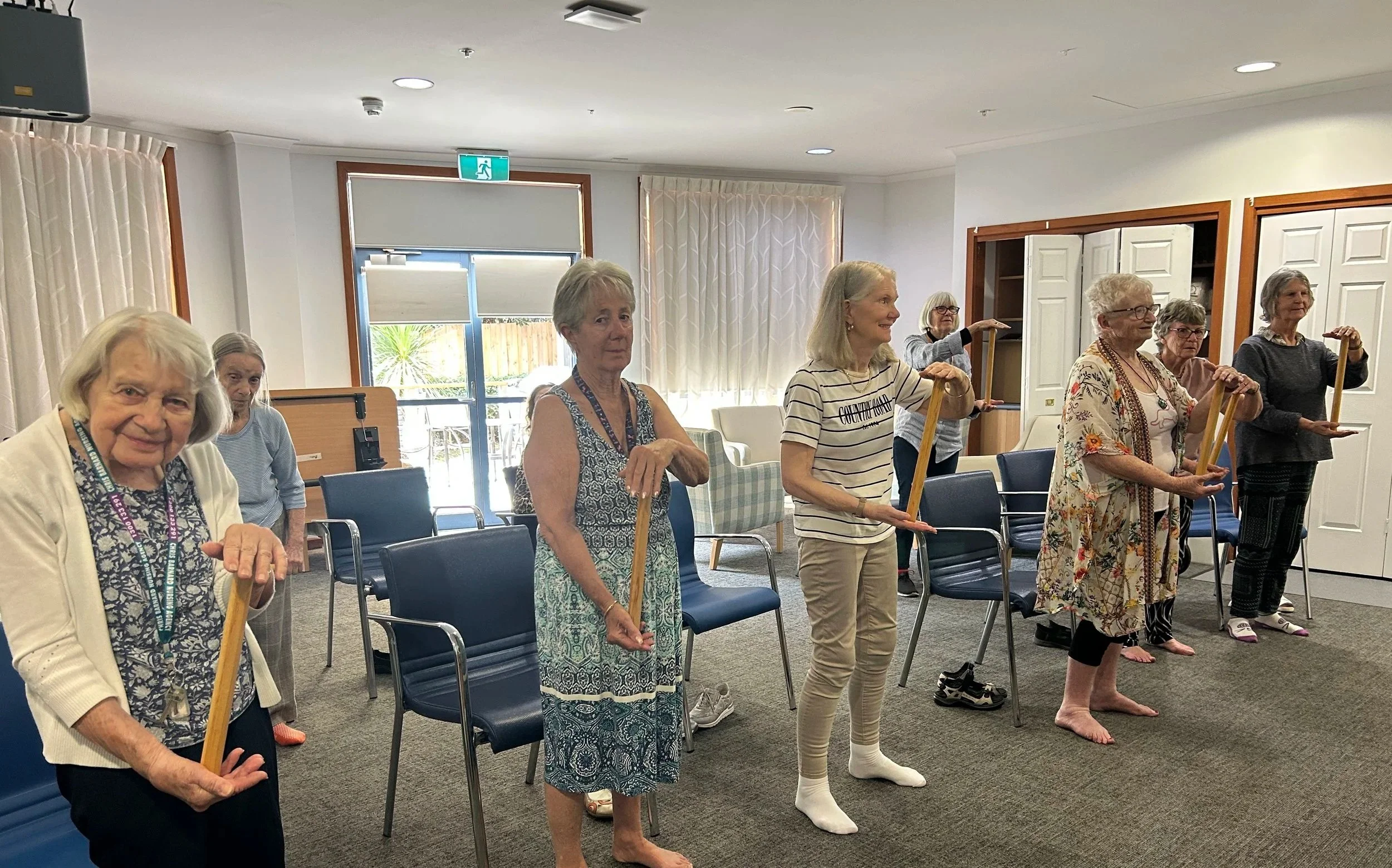
The banner above features residents at Benetas, Corowa Court, where I teach weekly Tai Chi and Qigong classes. For a long time, I worried that they weren’t getting much from my sessions—until staff shared that the residents genuinely look forward to them, and that the classes are a highlight of their week.
That feedback made me realise that everyone takes something different from a class. It’s important not to impose our own expectations or values on others—each participant attends for their own reasons, and each experience is equally valid. Some are not interested in remembering sequences, others aren’t concerned with learning something new. There are many reasons people continue to return to class, and it’s important that we keep an open mind about what matters most to them.
However, there are still ways we can ensure classes run smoothly and offer interest and challenge for everyone, without losing sight of individual needs.
The structure of the class has a natural progression
Explain concepts simply and vary explanations if a student has difficulty understanding instructions
Use imagery when explaining postures and techniques
Be confident with your own Form
Know how to break down each movement and each transition
Students may take 10 or 12 or 15 weeks to accomplish an ‘8 week’ programme. The length of time in the teaching framework is not important and it is not an issue if students require further practice, repeating the previous week’s practice.
Ask open questions – How did you feel? What do you think you did well? What would you like to improve? Students will begin to identify whether they were relaxed, whether transitions were smooth, whether they remembered the sequence of the postures, etc.
During each session, make sure students have the opportunity to ask questions. As students develop an understanding of tai chi, their questions will become more complex and thought provoking and can often be the subject of deep discussions. Their understanding of various concepts can be gauged by the type of questions they ask. Hence, encouraging questioning is an important tool in understanding the progress of the student.
If a student asks a difficult question, don’t be afraid to say, ‘I don’t know, but I will find out for you and we can discuss it next week.’
Encourage independence in students. If they are constantly watching the instructor or other students, their own practice is less likely to feel grounded. Developing independence takes time—often many weeks or even months—but it is an important part of Tai Chi practice.That said, some students are most comfortable simply following the instructor. In those cases, it’s important to respect that choice and avoid pushing anyone into a situation that feels stressful or discouraging.
Cultivate a friendly and inclusive environment by welcoming each person as they enter the venue and by using eye contact throughout the class.
At the end of the class, each participant should feel uplifted (this can be for many different, individual and personal reasons)