
The Art of Cueing
Cueing is a system of instructions, either verbal or nonverbal, which allows the class to know in advance the next transition, posture, direction, weight transference, etc. Many students (and in fact, all, new students) rely on sifu to guide the class with timely, consistent and clear instructions. Cueing is an acquired skill and is developed with practice and constant self-evaluation. Effective verbal cueing uses minimal words, it is given with enough time for processing, but not too early that students will move into the next posture too quickly. Verbal instructions should be spoken clearly but softly so the atmosphere of the tai chi class can remain calm and focused. Non-verbal cueing (arm and hand gestures) should be done with an open palm.
It is possible to talk too much! Give your students time to relax and breathe. Remember, the goal of Tai Chi is not necessarily to learn a Form - it’s to undertand, practice and enjoy the principles of movement and flow.
To cue effectively, the sifu needs to use mirror image and participant image. Using mirror image (where you are facing the students) is the best way to connect with the group, to gauge their understanding and engagement. Many Qigong exercises can be taught in mirror image - but this requires being able to use your right leg when cueing left! This takes practice but is well worth the effort as most students (not all) prefer this method of teaching. Participant image is when the sifu has his/her back to the students, and this is sometimes easier for the students to follow, but it’s difficult for them to see the arm movements.
How to Cue
Cueing itself, is an art, just like teaching and just like Tai Chi! Below are some tips that may be useful:
Cueing needs to be clear and consistent. This will enable your students to understand your timing and your cues.
Cue early enough for students to process instructions, but not too early that they short cut the previous movement.
Non verbal cueing can be the hand or arm showing the direction. Always use an open palm rather than pointing a finger
Use imagery to help students understand different concepts or postures
Try to vary the words you use
Avoid using the word ‘don’t’ as this creates negative thought
Cue the weighted leg, so students will know which leg will be stepping
Avoid over explaining. Give your students time to process. Give them time to breathe.
Choose one thing to focus on when cueing. It may be the arms, it may be the legs, it may be direction, etc
Using points of reference in the room may be easy in the short term, but in the long term, if they face a different direction, or if they’re in a different venue, they’ll become confused. Cue North, South, East, West, etc, or 45 degrees, 90 degrees, etc. Try not to use the word ‘corner’ as the corner will be different for each person, depending on where they are in the room.
Once you’ve taught and cued a movement (or short sequence sequence) a number of times let the students complete it on their own, without your help.
The pie chart below is quite an eye opener - only 7% of what is said by the instructor is processed by the student. 38% is the tone and the pitch of the voice, and 55% is through non-verbal communication, ie. body language. This is known as the 7-38-55 rule and is a result of a research conducted by a behavioural psychologist, Professor Albert Mehrabian. His research showed that when interpreting a message, the listener uses 7% of the verbal communication, 38% of the tone, pitch and pacing of the voice, and 55% of nonverbal communication to process the message.
Students, beginners in particular, will learn through watching rather than listening.
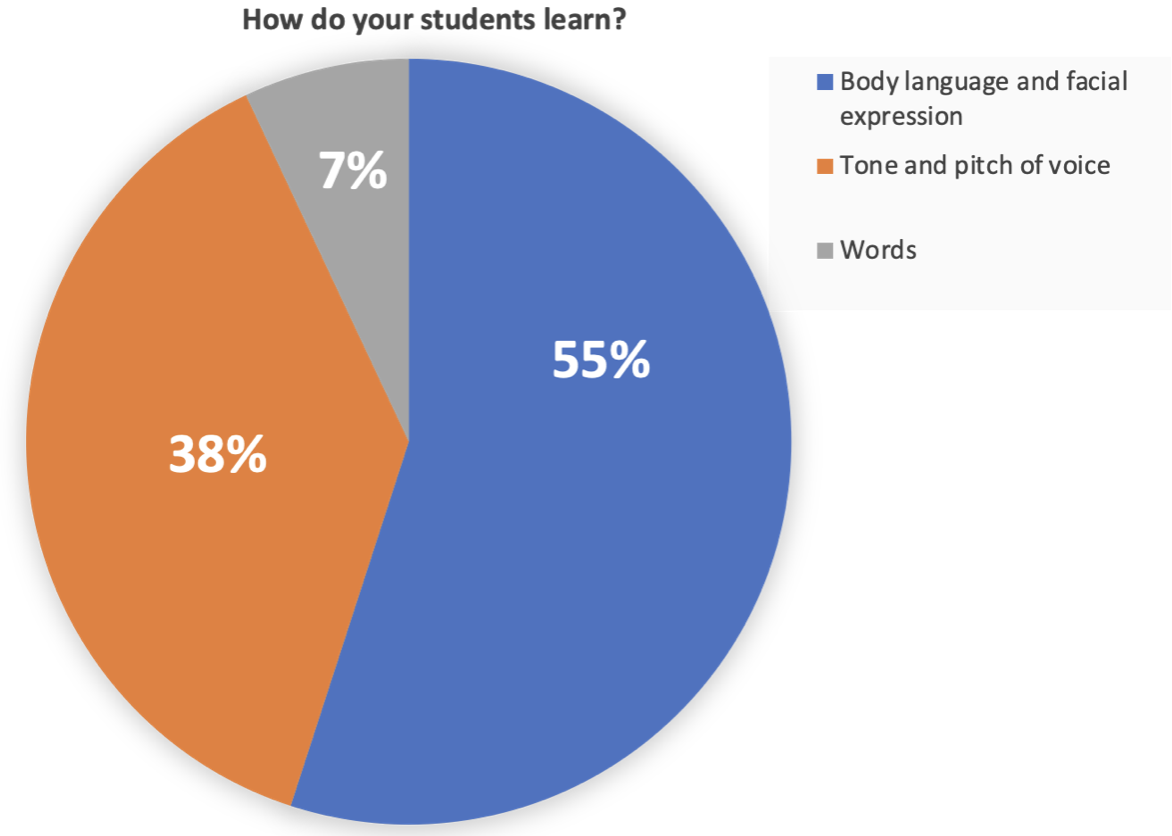
So, what does this information mean to the instructor? It means, particularly when teaching beginner students, that we need to demonstrate often, smile constantly and cue succinctly.
Having said that, there is difference between ‘teaching’ and ‘discussion’. We have many a good discussions during class - where everyone is involved and engaged, learning by asking questions and by being inquisitive. Beginner students, for the first few sessions, need teaching - then, when you have established a healthy rapport, they will enjoy exploring in more detail Tai Chi concepts and philosophy. They will also enjoy healthy and fruitful discussions.